



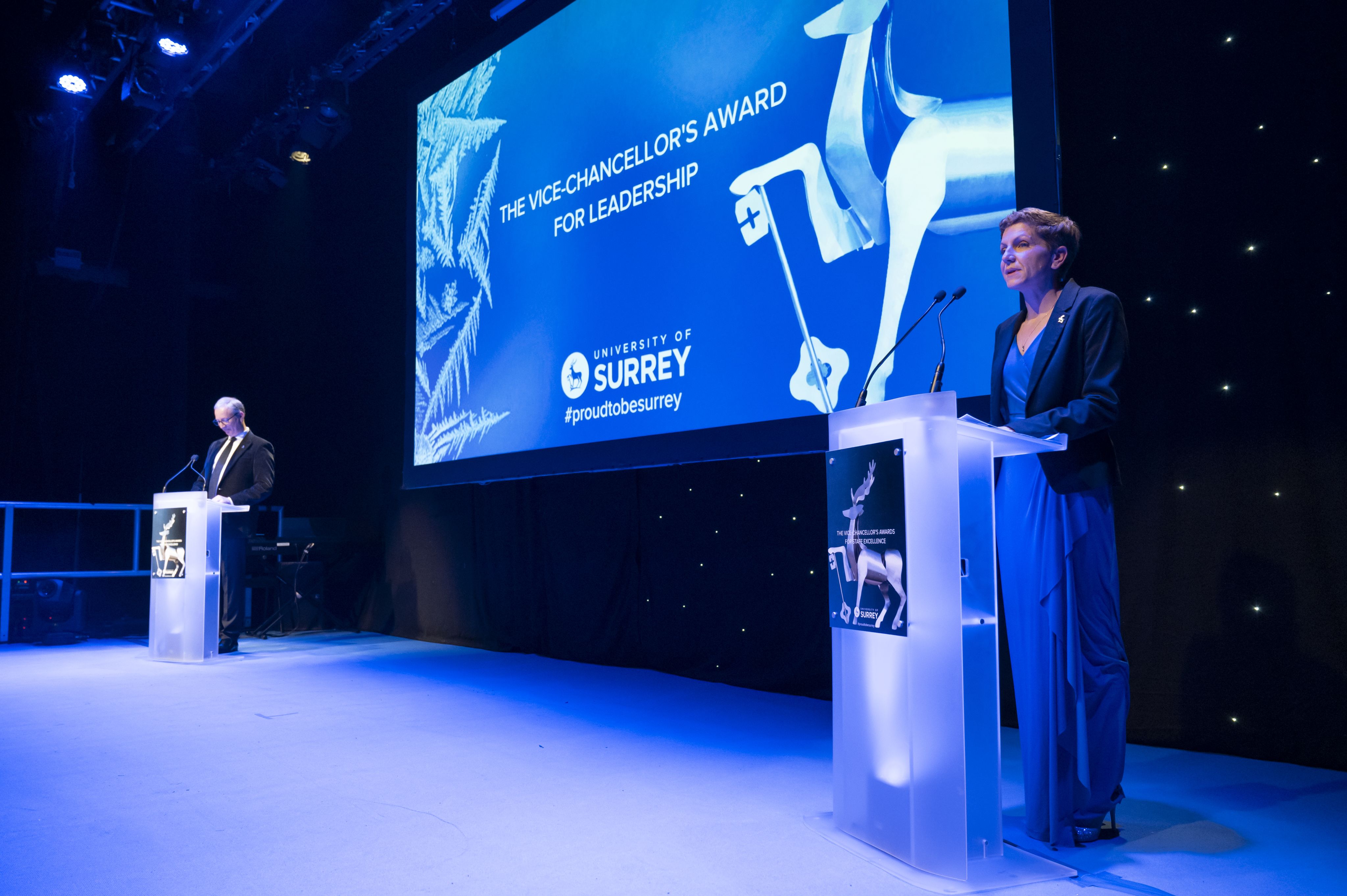
Meet the finalists of the
2025 Vice-Chancellor's Awards
The finalists for the 2025 Vice-Chancellor’s Awards for Staff Excellence have been named ahead of this year’s celebration evening at University Hall.
Each of the colleagues featured in the categories below is recognised for their exceptional performance and represents the very best of our Surrey community.
Read more about their contributions and achievements, then join our live stream on YouTube from 6.15pm on Wednesday 3 December to find out this year's winners.
To make the evening even more special, this is the first time that President and Vice-Chancellor, Professor Stephen Jarvis, will present the awards.
Congratulations to all our finalists!
Colleague of the Year
The Vice-Chancellor’s Award for Colleague of the Year recognises an individual member of staff who has markedly and consistently enhanced the working environment of other staff in the University, and exemplified our core values: Inclusion, Inspiration, Innovation and Integrity.
This year’s nominees are: Obai Frempong, Deborah Nottridge and Dr James Wright.
Obai Frempong, Programme Administrator, Academic Admin
Obai has consistently enhanced the working environment within the School of Veterinary Medicine through his unwavering support of the assessment process. Balancing his own workload with remarkable generosity, he exemplifies collegiality, professionalism and care for colleagues.
The impact of Obai’s contribution is widespread, and he embodies inclusion by ensuring fair access and support for all students. For example, when routine systems failed, he personally enabled students returning from temporary withdrawal to access their learning materials immediately, demonstrating his commitment to equity and the student experience. His approachable and friendly manner encourages colleagues to seek support without hesitation, creating a culture of openness and belonging.
Obai’s innovation is evident in the assessment systems he has implemented. By developing secure methods for remote marking and simplifying paper-based processes, he has made assessment workflows more efficient and resilient to the benefit of all.
Deborah Nottridge, Head of Catering, Campus Services Catering
Deborah consistently demonstrates an unwavering commitment to enhancing the student and staff experience. In her current role, she has transformed the catering provision across campus, ensuring excellence, innovation and genuine care for the University community.
Her positivity and ‘can-do’ attitude are infectious; she is renowned for always saying “yes,” finding solutions rather than problems, and approaching every challenge with optimism and professionalism. With over 30 years’ experience at the University, Deborah epitomises collegiality; staff love working with her because she makes collaboration easy and enjoyable.
What truly sets Deborah apart is her leadership style. She manages her team with dedication, empathy and a natural flair for bringing out the best in people. Whether mentoring a new colleague or guiding her team through busy summer conferences, Deborah leads with energy, encouragement, trust and respect. She has an instinctive management style that gets the best out of people.
Dr James Wright, Senior Lecturer in Chemistry, School of Chemistry and Chemical Engineering
Jamie stepped up to provide urgent cover for teaching and module leadership, programme leadership, PhD supervision and lead crucial curriculum changes in 2024-25 after a colleague fell ill for a long period, and another resigned, during a challenging time when the School's student numbers increased rapidly.
In addition, Jamie also took the initiative to develop an inclusive curriculum development process, following a Faculty Programmes Review. This enabled colleagues to develop new assessments in core modules to improve progression. He also volunteered to help develop novel training for Chemists on the Fluor Pilot Plant, a USP among Chemistry programmes in the UK, which is running in 2025/26. Additionally, Jamie has contributed significantly to the School’s outreach and marketing, supporting strong student recruitment. Despite being ‘teaching focussed’, Jamie has been instrumental in setting up the University’s new single crystal XRD instrument and designing the processes for researcher access.
Leadership
The Vice-Chancellor's Award for Leadership recognises an individual member of staff who has exhibited strong and effective leadership (or potential) by undertaking activities either formally through their role or simply by taking responsibility when leadership was required to achieve a particular goal.
This year's nominees are: Oliver Crenol, Becca Hill and Ed Paice.
Oliver Crenol, Head of Student Hub, Student Experience
Oli’s impact on the student experience is both profound and far-reaching. With a deep expertise in student support services, he consistently demonstrate professionalism, deep insight into the needs of students and an unwavering commitment to enhancing the student journey – all of which has led to measurable improvements.
His ability to manage complex projects and improvements while remaining accessible and supportive of colleagues is a testament to his exceptional organisational skills and emotional intelligence. Whether navigating high demand, service changes or responding to emerging student needs, Oli leads with clarity, compassion and purpose.
He fosters a collaborative environment where every voice is valued, and where innovation is encouraged. His support of colleagues - both within their immediate team and across departments - has cultivated a culture of mutual respect and shared success. Oli is not only a mentor and role model but also a trusted partner in driving forward initiatives that improve student wellbeing, engagement and inclusion.
Rebecca (Becca) Hill, Director of International Student Recruitment, International Recruitment
Becca is a huge driving force in the success of international student recruitment, exceeding both year-on-year performance for the recent academic intake and for sector trends (with over 1,600 international students registered for this academic year), providing strategic direction and empowering team members to achieve their objectives.
Becca fosters a truly aligned and supportive environment between international marketing and international recruitment – no small feat given the team is based both in the UK and overseas, and that the international marketing team did not exist two years ago.
She leads with a hands-on approach and champions the work of the team, whilst also amplifying and sharing successes. Becca creates an environment that allows team members to focus on building quality, mutually beneficial relationships across the University, and also provides networking opportunities and allows the right conversations to achieve and further ISR’s goals.
Ed Paice, Head of End User Computing, IT Services
Ed exemplifies outstanding leadership through his calm, inclusive and forward-thinking approach - consistently making decisions with the wellbeing and development of his team in mind. His ability to remain composed under pressure fosters a stable and supportive environment, enabling the team to thrive even during challenging periods.
Ed’s ethos of empowerment and collaboration runs deep in the teams he leads. He facilitates success across multiple areas: Field Support’s upgrade of thousands of machines to Windows 11; Audio-Visual’s consistent delivery of high-impact project installations; and the End User Computing team’s continuous rollout of feature updates that enhance staff and student experiences. These achievements reflect his commitment to operational excellence.
Beyond technical leadership, Ed actively contributes to improving systems and processes, ensuring IT Services remain agile and responsive to the University’s evolving needs. His collaborative style encourages innovation and initiative, fostering a culture of openness and trust.
Public and Community Engagement
The Vice-Chancellor's Award for Public and Community Engagement recognises colleagues or teams who have excelled in public engagement activities over the past year, enhancing the University's impact and reputation. This includes involving the public in research, sharing its benefits with non-academic audiences, or contributing to societal improvements through stakeholder or policy engagement. This award is open to any member of staff whose efforts have been over and above their normal core duties, and for whom public engagement is not their main role.
This year’s nominees are: Dr Matteo Giusti, The Surrey Circular Economy Group and Dr Fernando Oneissi Martinez Estrada.
Dr Matteo Giusti, Future Fellow in Sustainability Science, Centre for Environment and Sustainability
Matteo brings visible, inclusive and global recognition to Surrey’s sustainability research through BeNature, his transdisciplinary research on transformative sustainability learning. In partnership with Surrey Wildlife Trust and the Indigenous organisation Djandak (Australia), he authored the BeNature guide and toolkit for nature-based education.
Locally, Matteo leads a workshop for schools in Surrey at the ESRC Festival of Social Science to embed sustainability in their operations. With the Sustainable Innovation Hub, BeNature is shaping sustainability strategies across the City of London schools and Winchester Science Museum. He also secured funding for a BeNature theatre production to engage disadvantaged schools.
Nationally, he engages with Enterprise Education UK, the Nature Connectedness Network, and several conservation trusts. As a senior advisor for CIFAL, he also engages with business leaders for transformative sustainability.
Internationally, Matteo represents Surrey at the IUCN Taskforce for Nature-Based Education and will showcase BeNature at the IUCN World Conservation Congress 2025 in Abu Dhabi.
The Surrey Circular Economy Group
This interdisciplinary research group, which is currently part of a portfolio of projects worth £25 million, uses creativity, inclusivity and a strong commitment to two-way dialogue with society to demonstrate sustained excellence in public engagement.
A standout initiative is their Plastic Alchemy brand, most recently featured at the Royal Society Summer Science Exhibition 2025 - the UK’s most prestigious public engagement event - where thousands of people engaged with circular economy ideas through interactive demos, discussions and talks.
The Group maintains a broad portfolio of engagement activities; for example, Dr Lirong Liu serves as an energy expert and on-screen modeller for Energy Revolution, the on-going, major exhibition of sustainability at the Science Museum, which has welcomed over 700,00 visitors in its first year and has global reach through shared videos and animations.
The Group’s activities ensure their engagement resonates far beyond academia - influencing education, public understanding and global sustainability discourse.
Nominees: Prof Jin Xuan (Professor of Sustainable Processes, ADRI (FEPS)); Dr Hui Luo (Royal Academy of Engineering Research Fellow); Dr Iman Mohagheghian (Associate Professor in Mechanics of Materials); Dr Lirong Liu (Associate Professor in the Centre for Environment and Sustainability); Dr Lei Xing (Lecturer in Digital Chemical Engineering); Prof Jhuma Sadhukhan (Professor of Environmental, Energy and Chemical Engineering); Dr Lucy Elphick (Research Programme Manager)
Dr Fernando Oneissi Martinez Estrada, Senior Lecturer in Innate Immunity, School of Biosciences
Fernando demonstrates exceptional commitment to linking science, education and culture through community-led initiatives that empower Indigenous children and promote intercultural understanding.
He leads the creation of a Charitable Incorporated Organisation supporting Indigenous Mbyá-Guaraní (Mbiya-Warani) children in South America. Building on his creative and educational work, Fernando co-develops bilingual children’s books that celebrate Indigenous knowledge and storytelling. Each book is produced collaboratively with the communities, ensuring authenticity, respect and tangible local benefit while engaging global audiences.
His work has received international recognition, inspiring young learners about science, culture, and shared humanity. Proceeds from book sales will be reinvested into educational programmes for Indigenous children, with translations into Portuguese and Sinhalese underway to extend access to Brazil and Sri Lanka. Future editions aim to reach African communities.
Through this innovative and compassionate model, Fernando is creating lasting bridges across continents - linking creativity, equity and education.
Equality, Diversity and Inclusion
The Vice-Chancellor's Award for Equality, Diversity and Inclusion recognises an individual member of staff who has substantially contributed to the development and/or celebration of our diverse and inclusive culture by, for example, acting as a positive role model who consistently champions equality, diversity and inclusion, or developing events and activities with demonstrated outcomes.
This year’s nominees are: Olawale Arowolo, Dr Fabio Fasoli and Dr Lisa Morrison.
Olawale Arowolo, Research & Evaluation Officer - Student Access & Participation, Strat, Plan & Perf
Olawale has made a significant contribution to making the University a more equitable and inclusive environment, primarily through evaluating Access and Participation Plan (APP) activity; this supports under-represented and marginalised students to access, succeed in and progress from Surrey. His analysis of the University’s strengths and areas in which it can improve continues to develop and enhance our data tracking, evaluation and analysis.
Olawale has brought together teams across the University to develop and launch a new evaluation outcomes framework and delivered training and bespoke support to develop the evaluation capabilities and confidence of both professional service and academic staff members delivering EDI and APP initiatives.
He also worked cross-institutionally to develop and implement the first Student Success Questionnaire (SSQ). Completed by two-thirds of our student population, the SSQ uses robust, validated scales to measure self-reported knowledge and attitudinal outcomes that will inform proactive student support and intervention and enable long-term evaluation and monitoring of student progress.
Dr Fabio Fasoli, Senior Lecturer in Social Psychology, School of Psychology
As well as being prolific in his academic capacity, Fabio excels in his role as the Chair of the staff LGBTQIA+ Rainbow Network, showing unwavering commitment to fostering belonging and understanding, particularly during moments of profound challenge.
Fabio is a steady, compassionate presence - guiding students and colleagues through complex and often painful conversations. His gentle leadership has created spaces for reflection, empathy and open dialogue, allowing individuals from all backgrounds to feel seen, heard and valued. He consistently shows up, advocates for underrepresented voices in decision-making processes, and helps to ensure that inclusive practices are embedded in our University’s daily operations.
In all he does, Fabio demonstrates that true leadership is not about recognition, but about service and integrity. His tireless dedication on behalf of the LGBTQIA+ communities has ensured that Surrey is a university of choice for many LGBTQIA+ students and staff.
Dr Lisa Morrison, Lecturer and Physics Admissions Tutor, School of Mathematics and Physics
Lisa is a model ally and advocate for disabled students, who always strives to provide personalised support to individuals with complex needs and to create an inclusive learning and teaching environment. Her dedication and passion for supporting disabled students creates a more cohesive support network, and she has referred multiple students to the Disability and Neuroinclusion (D&N) team who may otherwise have not engaged with the services available.
Lisa has created a bespoke plan for inclusive presentations which allows students to opt for any one of five ways to engage without requiring them to disclose nor provide reasoning. She has also helped to support a very independent student with sight loss, ensuring they had the adjustments and support they need to access exams and learning. Lisa worked closely with multiple members of D&N and the Centre for Wellbeing to support a student with significant and complex mental health difficulties and was key in helping them to graduate.
Wellbeing, Health and Safety
The Vice-Chancellor's Award for Wellbeing, Health and Safety recognises colleagues who excel in fostering a safe, supportive environment and promoting a culture of care. It celebrates outstanding contributions to health, safety, and wellbeing, recognising exceptional efforts to enhance practices within departments. The award also highlights innovative approaches to improving physical and mental wellbeing and acknowledges leaders who champion mental health awareness and create open, supportive workplace environments.
This year’s nominees are: Holly Jones, International Mobility Team and Emily Pentland-Hill.
Holly Jones, Student Wellbeing Administrative Coordinator, Centre For Wellbeing
Holly shows outstanding leadership and continuous commitment to supporting the wellbeing of students. Described as ‘the heart of the admin team’, Holly is always approachable, calm under pressure and ready to step in wherever support is needed.
Holly's support behind the scenes has a ripple effect across the whole wellbeing service. Thanks to her leadership, the admin team feels more connected, valued and empowered and that has a direct impact on the wider wellbeing support the ThriveWell team is able to provide.
She has played a key role in developing safeguarding procedures and risk management systems that strengthen how the University supports students in need. Some students arrive at the Centre of Wellbeing in a highly distressed or agitated state, but Holly always responds with calm professionalism and compassion - often going above and beyond her role to ensure they feel safe and heard and managing conversations with students, families, and staff with sensitivity and care.
In so doing, Holly creates a genuinely inclusive environment and ensures every voice is valued and every individual feels supported.
International Mobility Team, International Engagement Office, Global
The International Engagement Office Mobility Team consistently fosters a healthy, safe and supportive environment for students and colleagues. It has significantly strengthened Surrey’s duty of care through enhanced collaboration with Health & Safety and academic colleagues to improve risk assessment and learning agreement processes with partner institutions. These developments ensure consistent, transparent and student-centred safeguarding measures for those studying and working abroad.
The team developed comprehensive wellbeing resources on the Surrey Abroad platform to guide students on a range of topics and their pre-departure briefings provide practical and cultural preparation, fostering resilience, confidence, and peer support. For incoming exchange and study abroad students, the team provides pre-arrival guidance, delivers webinars and have strengthened support for those with additional needs through active referrals to wellbeing and disability services.
To promote belonging, the team introduced regional WhatsApp groups for students to connect, a Buddy Network and storytelling initiatives through blogs and social media to share authentic student experiences.
Nominees: Alice Gidman (International Mobility Officer); Ben Rogers (International Mobility Coordinator); Emily Bushnell (International Mobility Coordinator); Jane Pango (International Mobility Coordinator); Louisa Leung (International Mobility Coordinator); Zoe Stevenson (International Mobility Coordinator).
Emily Pentland-Hill, Associate Director of Student Experience, Chief Student Office
Emily fosters a healthy, supportive and people-first culture within the Student Experience team and across the wider University community.
One of her most impactful initiatives has been the introduction of wellbeing walks for the Student Experience team. These informal walks around campus provide colleagues with an opportunity to step away from their desks, connect with each other and re-energise. They have significantly strengthened team relationships while improving staff wellbeing and resilience during demanding periods.
Emily also facilitates regular reflective practice sessions that encourage colleagues to pause, share and reflect on both their own wellbeing and that of those around them.
By championing staff across her directorate she ensures that student wellbeing remains the number one priority and by empowering colleagues, modelling empathetic leadership and embedding a ‘people first’ ethos, she has enabled her team to balance high-quality service delivery with compassionate, student-centred practice.
Innovator of the Year
The Vice-Chancellor’s Award for Innovator of the Year is presented to an individual who has developed an outstanding innovative product, technology, process or service that clearly demonstrates an economic, social or environmental benefit to society.
This year’s nominees are: Prof Rich Bowden, Dr Maria Kardakova and Dr Brigitte Stangl.
Prof Richard Bowden, Professor in Computer Vision and Machine Learning, Surrey Institute for People-Centred AI / Centre for Vision, Speech and Signal Processing
Richard is transforming accessibility through pioneering, ethical AI for sign language translation. For over two decades, his research has advanced inclusive technology that works with Deaf stakeholders to improve communication and access worldwide. His University of Surrey spinout Signapse employs Deaf professionals and delivers real-time sign language translations for transport networks, cultural institutions and digital platforms across the UK and US. Bowden’s commitment to responsible innovation ensures that technology enhances, rather than replaces, human interpreters.
Recognised by government and industry, over just the last few years, his work has attracted over £8.45 million in UKRI funding and US $1.5 million from Google’s philanthropic arm for University research. A visionary researcher and ethical innovator, Professor Bowden’s achievements are driving profound social, cultural, and economic impact-empowering Deaf people and redefining how AI can make society more inclusive.
Dr Maria Kardakova, PGR / Honorary Research Fellow, School of Biosciences
Maria transforms world-class preventive epidemiology research into real-world impact. During her PhD, she investigated how lifestyle factors shape the gut microbiome and, in turn, metabolic and mental health, analysing data from more than 7,500 individuals.
Translating this multi-layered health data approach into practice, she founded iCook, an AI-powered nutrition platform that combines large language models, population health insights, and behavioural data to personalise nutrition at scale.
The platform now supports over 250,000 users worldwide, turning complex scientific evidence into practical dietary guidance aligned with NHS and UK EatWell standards. Recognised nationally for its innovation, iCook was named a Finalist for AI Startup of the Year at the UK National AI Awards 2025, praised for its robust growth metrics, measurable healthcare impact, and secure, explainable AI architecture.
Dr Brigitte Stangl, Associate Professor in Tourism, Surrey Business School
Brigitte transformed an idea about tourism’s skills shortages into a pioneering social innovation. Her research into socio-emotional and transferable skills secured European Travel Commission funding and led to a collaboration with publisher Graffeg to create two children’s book series - Dee and Flee and Searchlight - which reframe tourism as a lifelong skills incubator.
She then led the University’s first social-science project through Innovate UK’s ICURe programme, developing a prototype educational game and an intergenerational learning platform connecting children and older adults through play. With further support from GAIN and Innovate UK, her spin-out, ConnectPlayWise Ltd, now integrates research, wellbeing, and digital innovation. Brigitte’s structured “path of impact” model demonstrates how academic insight can generate tangible social, educational, and economic value, positioning her as a leading figure in research-driven innovation.
Researcher of the Year
The Vice-Chancellor’s Award for Researcher of the Year recognises colleagues whose recent research has successfully challenged dogma, created a new field of research, elucidated a new paradigm, made a fundamental change in thinking, or had a significant impact on society.
This year’s nominees are: Prof Enzo De Sena, Prof Jill Maben and Dr Ethan Taylor.
Professor Enzo De Sena, Professor in Audio, Institute of Sound Recording
The common thread of Enzo’s research is combining engineering and psychoacoustics to make audio experiences in gaming, surround-sound systems, and virtual/augmented reality more realistic and immersive. His work influences research and practice in his field, receiving best-paper awards at leading venues.
His research in room acoustic modelling underpins audio rendering in popular games and is implemented in open-source tools widely adopted across big tech, quietly shaping the audio experienced by hundreds of thousands of people every day; while his research on surround sound has been showcased as part of high-profile artistic installations, including at the National Gallery and the Royal Society, and his work on sonification attracted significant media attention, reaching millions of viewers.
Enzo leads a team of nine doctoral and postdoctoral researchers, supported by funding he secured from research councils and industry. He leads the £2.2 million national strategic infrastructure project, AURORA³, bringing to Surrey world-first facilities for audio and acoustics.
Prof Jill Maben, Professor of Health Services Research and Nursing, School of Health Sciences
Jill is world-renowned for outstanding research and research leadership in: NHS staff wellbeing; fitness to practice processes; unprofessional behaviours between staff; Schwartz Rounds; Freedom to speak up Guardians; and evaluations of single hospital bedrooms.
She’s had an outstanding year, having been awarded: an NIHR £5m workforce partnership project ‘Exploring staff wellbeing through innovative partnerships to enable staff to care well under pressure and thrive at work’; and a highly prestigious second four-year term as an NIHR Senior Investigator. The latter recognises the most prominent and prestigious researchers of applied health and social care in the country who shape the direction of health and social care and public health research in the UK.
Dr Ethan Taylor, Research Fellow, School of Mathematics and Physics
Ethan is a rising young star in computational astrophysics. Despite being just one year out from his PhD, he has just published a lead-author Nature paper: “The emergence of globular clusters and globular-cluster-like dwarfs”; this solves a centuries-old problem - how do globular star clusters form?
Using a suite of state-of-the-art computer simulations run on the National DiRAC supercomputer, Ethan showed how globular clusters naturally emerge in his simulations. At the same time, he predicted the existence of a new type of object - like a globular cluster but rich in mysterious, invisible, "dark matter". These new objects may have already been found in our cosmic backyard. If so, they hold new clues to the nature of dark matter and the physics of the very first stars that formed in the cosmos.
Research Supervisor of the Year
The Vice-Chancellor's Award for Research Supervisor of the Year recognises an individual or supervisory team who has/have created the most supportive, stimulating, and inspirational research environment for their postgraduate researchers during their time at the University.
This year’s nominees are: Dr Andy Gilbert, Dr Simon Hadfield and Dr Haomiao Jin.
Dr Andrew Gilbert, Associate Professor of Computer Vision and Machine Learning, Music & Media
Andrew's research supervision brings together creativity, care and curiosity. Within the Centre for Creative Arts and Technology (C-CATS), he has cultivated an inclusive, collaborative community where every researcher feels valued and supported in their growth.
His supervision combines structure with empathy - regular group meetings, one-to-one mentoring, and shared activities that strengthen confidence and a sense of belonging. Andrew’s open, interdisciplinary approach encourages students from computing, psychology and the arts to learn from one another and to approach research as a creative, human endeavour.
A passionate advocate for equality, diversity and wellbeing, Andrew leads his disciplines' Athena Swan work and contributes nationally to postgraduate training. His commitment to nurturing people and projects exemplifies the spirit of the University’s research culture - developing thoughtful, capable researchers who thrive both within and beyond academia.
Dr Simon Hadfield, Associate Professor, Surrey Institute for People-Centred AI / Centre for Vision, Speech and Signal Processing
Simon creates an exceptionally supportive and intellectually vibrant environment. His supervision combines rigour, care and an unwavering commitment to student success, both academic and personal. Through weekly one-to-one meetings, collaborative group discussions and monthly reading groups, Simon cultivates critical thinking, collaboration, and research excellence.
Simon prioritises reasoning over technical advice, helping students reach robust, independent conclusions. He mentors students through innovation programmes like ConceptionX and ICURe and empowers them to present and publish at leading international conferences. His hands-on approach, offering timely feedback at all hours, has led to consistent student success, including national thesis prizes and top-tier publications.
Beyond academic achievement, Simon is deeply invested in his students’ wellbeing and long-term goals, fostering a culture of generosity, collaboration and confidence. This dedication exemplifies what outstanding research supervision should be: challenging, inspiring and genuinely transformative.
Dr Haomiao Jin, Lecturer, School of Health Sciences
Haomiao’s calm, insightful and compassionate supervision fosters a supportive and intellectually stimulating research culture. Drawing on expertise in digital health, statistics and AI, and self-report data, he empowers each doctoral researcher to develop independence while providing meticulous methodological guidance. His students describe him as patient, encouraging and transformative - helping those with limited quantitative backgrounds gain confidence in advanced statistics and data science.
Haomiao’s projects span AI for cognitive decline prediction, accessible digital surveys for visually impaired users and digital health interventions for chronic disease. Under his guidance, PGRs have produced high-quality publications and international presentations. As International PGR Tutor of the School, he also champions inclusion and wellbeing among the School’s diverse research student community.
Postgraduate Researcher of the Year
The Vice-Chancellor's Award for Postgraduate Researcher of the Year recognises exceptional postgraduate researchers based on the excellence and breadth of their cumulative research achievements and acknowledging those who are on a rising trajectory, actively contributing to their field and achieving meaningful impact through their work.
This year’s nominees are: Prince Okyere, Vera Spangler and Sophie Tudge.
Prince Okyere, Postgraduate Researcher, School of Psychology
Prince is a final-year PhD researcher in neuroscience at the School of Psychology. His doctoral work investigates how non-invasive brain stimulation can influence sleep-dependent memory consolidation, focusing on temporal interference stimulation (TIS), a novel technique using low-intensity electric fields to target deep brain regions. He has developed the application of TIS during sleep to target the hippocampus to facilitate memory reactivation, with potential applications for supporting individuals with memory impairments such as dementia.
Since beginning his PhD in 2022, Prince has published in high-impact journals including Brain Stimulation and PLoS Biology and presented his research internationally at Organisation for the Human Brain Mapping (OHBM), the Brainbox Initiative Conference, Oxford’s International Sleep Replay Conference, the IT’IS Foundation in Zurich and the UK Dementia Research Institute.
Beyond research, Prince shares knowledge through guest lectures on mental health and sleep science in the UK and Ghana, bridging neuroscience with global education.
Vera Spangler, Postgraduate Researcher, Department of Sociology
Vera is an international postgraduate researcher whose doctoral work investigates knowledge legitimacy and the role of international student mobility in the (re)production of global hierarchies. She has conducted ethnographic fieldwork across universities in the UK, Denmark and Germany, using participatory and creative methods to explore how knowledge is produced, valued and contested. She further extended her project through a three-month PhD placement in Chile.
Since starting her PhD, Vera has submitted seven sole-authored articles (three published, one accepted, three under review), plus three collaborative articles under review. She has delivered eight conference presentations and engaged diverse audiences through workshops, blog posts and a one-month online Image-Maker residency showcasing visual material from her fieldwork.
Vera is highly active in the academic community, contributing through teaching, co-convening professional networks, organising events and serving on institutional committees. Through these activities, she seeks to foster welcoming and supportive spaces for postgraduate and early-career researchers.
Sophie Tudge, Postgraduate Researcher, Centre for Environment and Sustainability
With a background in environmental science and ecology, Sophie strives to help balance the needs of human society with the conservation and restoration of biodiversity. During her PhD, she developed innovative modelling methods to assess the effects of global land-use change on biodiversity.
Her research addressed important, time-sensitive questions about the ecological effects of specific drivers of land-use change, including bioenergy expansion and tree planting. Her results are essential for making future land-use decisions that are in line with sustainable development, bridging the disciplines of energy production, climate-change mitigation, agriculture, forestry and biodiversity conservation.
Sophie has published five articles in leading ecology and conservation journals, with an additional two in peer review. She has also built research collaborations with organisations including the Natural History Museum and the International Institute for Applied Systems Analysis in Austria. She was recently awarded her PhD with no corrections, highlighting the quality of her research.
Teacher of the Year
The Vice-Chancellor’s Award for Teacher of the Year recognises and rewards staff who have been teaching at the University of Surrey for three or more years and have made a significant contribution to enhancing students’ learning experience and the quality of their learning.
This year's nominees are: Dr Emily Finch, Dr Lisa Morrison and Dr Dynatra Subasinghe.
Dr Emily Finch, Associate Professor, Surrey Law School
Emily’s teaching is characterised by her commitment to students and her unwavering belief in their potential. She has a long-standing interest in the emotions attached to learning and works with students to create learning activities that build skills, confidence and a sense of ease with difficult material. She aims to ensure that each of her 400-plus students feels known and supported as an individual.
Her interactive classes connect students with the law as it operates in society and highlight the skills that lawyers need in practice. She seeks to inspire and surprise, fostering curiosity about the law that continues long after class has ended.
Outside the classroom, Emily uses the World Café method to explore the learning journey from the student perspective. This has led to a redesign of assessment support within her modules and the development of well-attended extracurricular skills sessions that help students feel more confident, capable and motivated in their studies.
Dr Lisa Morrison, Lecturer B, School of Mathematics and Physics
Central to Lisa’s approach is her belief that student success is inherently tied to their wellbeing and sense of belonging. Lisa’s background is in nuclear physics and she teaches students across Levels 4-6, including in the experimental laboratories. She was recently awarded the Lewis Elton Award for demonstrating innovation in her teaching during the PGCert programme and has secured funding from the FEPS Teaching Innovation Fund. Lisa recently redesigned teaching and assessment approaches to Level 4 laboratories and she directly feeds into School-wide teaching initiatives as part of the School Teaching & Learning Committee.
As Senior Personal Tutor and Admissions Tutor for Physics, Lisa adopts a holistic approach to academic and pastoral support at all stages of a student’s journey working with colleagues across her School, Faculty, and the University more widely, in order to ensure her students are best placed to succeed on their course.
Dr Dynatra Subasinghe, Associate Professor in Small Animal Clinical Practice, School of Veterinary Medicine, ADE FHMS
Dynatra prioritises student preparedness and professional competence as a small animal clinical practice educator. Awarded Principal Fellowship of Advance HE in 2025, she designs and delivers innovative, evidence-based teaching that transforms veterinary education through engaging, technology-enhanced, dynamic learning environments.
Her approach emphasises real-world readiness through novel teaching sessions for complex clinical concepts, directly enhancing student workplace confidence. As Curriculum Committee Chair, Dynatra pioneered equality, diversity and inclusivity and sustainability teaching within the BVMSci curriculum.
Her influence extends nationally and internationally through collaborations with the Royal College of Veterinary Surgeons UK and Sri Lanka College of Veterinary Surgeons. As Clinical Programme Leader, she contributed to Surrey's BVMSci programme achieving UK and European accreditation.
Dynatra's commitment to developing educators and improving student outcomes has established Surrey's distributed veterinary clinical education model as an international exemplar.
Early-Career Teacher
of the Year
The Vice-Chancellor’s Award for Early-Career Teacher of the Year recognises and rewards staff who are within their first three years of teaching and have made a significant contribution to enhancing students’ learning experience, and quality of learning.
This year's nominees are: Dr Christina Ratcliffe, Dr Kai Yang and Dr Yuan Zou.
Dr Christina Ratcliffe, Lecturer in Veterinary Wellbeing, School of Veterinary Medicine
Christina demonstrates sustained excellence in teaching and inclusive practice across the BVMSci programme. As School Disability Liaison and Vet School EDI Committee Representative (Disability & Neurodiversity), Christina led the development of new processes to support disabled and neurodivergent students, now adopted across the Vet School and attracting cross-School interest.
Christina’s teaching reflects a pedagogy of care and students appreciate the additional resources she creates to support diverse learners. Her module leadership was also highly praised by students and influenced wider VLE design. She has contributed to inclusion-focussed research within the faculty and contributes to conversations around inclusive practice within the wider veterinary profession.
Dr Kai Yang, Lecturer in Energy Materials & Nanotechnology, Advanced Technology Institute, Computer Sciences and Electrical Engineering
Since joining Surrey in 2023, Kai has made a remarkable impact on teaching and student development. Through the Battery and Electrical Systems module, he has created a dynamic, research-informed learning experience that bridges electrochemical theory with real-world applications. His innovative approach integrating visual demonstrations, lab tours, interactive quizzes, and guest sessions with PhD researchers and industrial collaborators, achieved 100% student satisfaction in 2025. The module has also inspired many MSc students to pursue research projects within his group, leading to excellent outcomes and journal publications.
Kai actively connects students with the wider academic community through ATI and Surrey seminars and workshops, broadening their research and career perspectives. He offers personalised career guidance and continuously refines his teaching based on graduate feedback and evolving industry needs, strengthening the link between teaching and employability. He also promotes interdisciplinary learning through collaborative cross-school sustainability projects. Beyond the classroom, he leads inspiring sessions at Open and Offer Holder Days, demonstrating Surrey’s inclusive, research-led education.
Dr Yuan Zou, Lecturer in Translation Studies, School of Arts, Humanities and Creative Industries
Yuan has made outstanding contributions to curriculum design and pedagogical innovation across CTS Master’s programmes. She led the redesign of Public Service Interpreting into Public Service Interpreting and Translation, expanding access for MA Translation students and preparing the module for wider delivery, including future CPD for public-sector professionals. She is also co-developing the Professional Translation Practice module into a multilingual format, a strategic shift that enhances CTS’s capacity to support students across diverse language pairs. In Audiovisual Translation, Yuan integrates her research on game accessibility, audio description and AI into teaching, enriching learning with cutting-edge research and opening new career pathways.
Yuan plays a key role in strengthening student employability. She organises the CTS Professional Engagement Seminars and the Careers Fair, linking academic learning with industry engagement and creating valuable opportunities for students to build networks. Her innovative, inclusive and research-informed approach has made a demonstrable impact on student experience, employability and career development.
 Built with Shorthand